 Community Power Club
 Power Back Community Energy
 The generators we work with
 Corporate Volunteering
 Community Energy Kickstart case study
 Powering Communities Fund case studies
 Community energy blogs
 Community energy events
 What is community energy?
 Our team
Earn more for your project with Community Power Club
We're excited to introduce our Licence Exempt Supply offering, a brand-new product designed to help community generators earn more from their projects by supplying energy to their members and local communities.
How it works

Register your interest
Hold an active PPA with Younity and register your interest in joining the Community Power Club.

Build your club
Choose who can become a member and who can benefit from your Licence Exempt Supply.

Everyone benefits
When members consume electricity as your project generates it, your project earns more and members pay less on their energy bills.
Spare spots in your club? Don't worry, we can fill them too
While you fill your club with the members that matter to you, we've partnered with Octopus Energy Business to fill any spare spots with their business customers.
This doesn't have to be permanent, but lets you start maximising value for your organisation from day one!
What does this mean for your members?
You'll be able to invite households and businesses of your choosing to join your club and share in the benefits of your Licence Exempt Supply.
You'll be in control of your club, choosing who to invite as long as they meet the eligibility criteria. Keeping that control with you is really important to us.
- A dashboard for every club, showing members how much of their electricity use has been matched with your generation.
- Track club performance overall, helping everyone understand their energy use and their matching.
- Bill discounts when it matters — members save when they consume power at the same time your project generates it. The discount size varies with the levy rate in each half-hour period.
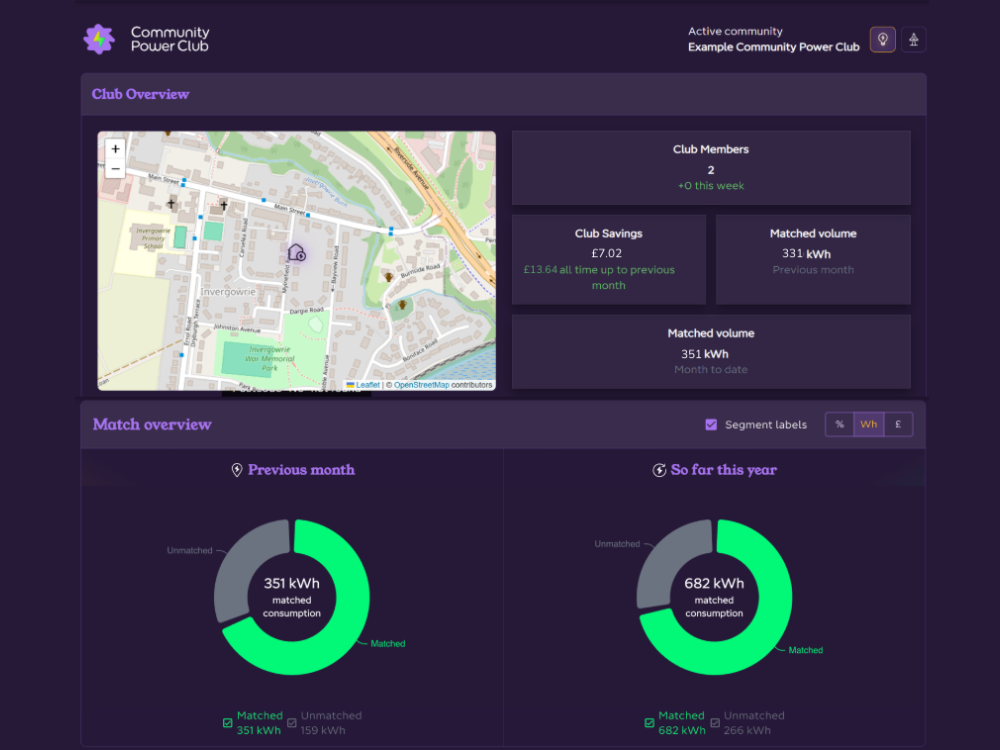
Community Power Club, in action
"The Community Power Club gives our co-op a stronger connection with our members.
It gets us the most from our PPA, increases our community focus and supports homes and businesses by saving them money — all while thinking about long-term energy security."
Zach Wishart, Director
Who's eligible to join?
-
Community Energy Generators
Need an active PPA with Younity.
-
Households
Need to be on the Community Power Tariff , the only tariff on the market that is 100% powered by community-generated electricity, and have a smart meter.
-
Businesses
Need to be on an Octopus Energy Business tariff and be half-hourly settled.
We also know this tariff won’t suit every household, for example, those with solar panels or EVs. That’s why we’ll also support a number of Octopus Smart Tariffs.
Common questions
What is Class A Licence Exempt Supply?
Class A Licence Exempt Supply is designed for small suppliers, enabling small scale generators to supply no more than 5MW without needing a fully supply licence. No more than 2.5MW of this can be supplied to domestic customers. The legal definition from the UK's Electricity Order 2001 is as follows:
Class A: Small suppliers
Persons (other than licensed suppliers) who do not supply any electricity except electricity which they generate themselves and who do not at any time supply more electrical power than 5 megawatts of which not more than 2.5 megawatts is supplied to domestic consumers.
A.1. For the purposes of Class A electrical power supplied by a body corporate which is associated with any supplier shall be treated as supplied by that supplier.
What is Licence Exempt Supply?
Licence Exempt Supply allows electricity generators to supply directly to consumers without having to hold a full electricity supply licence, under certain conditions as set out in the UK's Electricity Order 2001.
There are different classifications of licence exempt supply and these have different eligibility criteria, some also have specific volume limits.
Who is eligible to be a Class A licence exempt supplier?
To be a Class A licence exempt supplier you need to be:
- Supplying electricity which you have generated yourself, such as through Solar PV, Wind or Hydro.
- Be supplying, across all classifications of licence exempt supply, no more than 5MW (of which no more than 2.5MW per hour supplied to domestic customers) of supply. N.B. These limits are applied per body corporate, meaning any Special Purpose Vehicles (SPVs) or associated bodies will be considered together with your organisation as one entity, not separately.
- Not be in receipt of ROCs or FiT export.
Please note you are responsible for confirming your eligibility under the Class A Licence Exempt Supply rules and ensuring that you remain compliant.
What is Class C Licence Exempt Supply?
Class C Licence Exempt Supply applies to on-site and private wire supplies. It allows generators to supply directly to specific consumers on the same site, or via private wires, without needing a fully supply licence.
The definition of a Class C Licence Exempt Supply is set out in the Electricity (Class Exemptions from the Requirement for a Licence) Order 2001.
Still have questions?
Our Community Renewables Managers are on hand to talk through your project and answer any questions directly.
Sell the energy generated by your community energy project
We buy power from over 1/3rd of community energy groups across the UK, no matter the size of the generation.
The Community Power Tariff
Want to power your home with community energy while supporting local groups across the country?